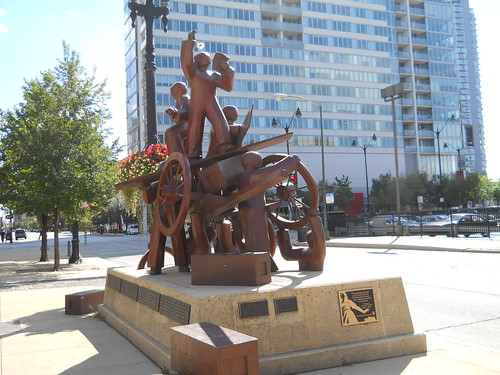
 The commemorative memorial in Haymarket Square, Chicago
In the early United States, labor unions were outlawed--they were considered to be illegal conspiracies in restraint of "free trade". That changed in 1842, when, in the Huntcase, the courts ruled that collective bargaining was legal and that workers could form unions and associations. At first, labor unions were small, weak, and rarely extended beyond the employees of one company. Most workers continued to be paid starvation wages, for which they worked as much as 12 hours a day, sometimes seven days a week. But as economic conditions for labor worsened after the Civil War (and the financial Panic of 1873 caused economic chaos), American workers became more militant. When the 1877 national railroad strike broke out and paralyzed the entire country, no labor union had organized or led it--the strike had grown spontaneously from the railroad workers themselves. Over 100 strikers were killed in street battles across the country as President Rutherford B Hayes sent in State and Federal troops to crush the strike. In response, workers in all industries began to organize, first with the Knights of Labor and then with the Federation of Organized Trades and Labor Unions, which would later change its name to the American Federation of Labor.
In 1882, the Federation called for an all-out campaign of nationwide protest actions to win a law enforcing an eight-hour working day. To allow enough time for organizing and educational agitation, the starting date for this national campaign was set for May 1, 1884. On the appointed day, huge rallies and protest marches were held in every major city in the US. And the largest May Day demonstration happened in the leading industrial city of the US--Chicago. Over 80,000 of the city's workers marched up Michigan Avenue with signs that read "8 Hours for work, 8 hours for rest, 8 hours for what we will!" and "Shorter hours increases the pay!"
Chicago's local labor movement was dominated by radical Socialists and Anarchists. Two of the organizers of the May Day march had been Albert Parsons, a printer by trade who edited the local anarchist newspaper The Alarm, and his wife Lucy, a Mexican/African-American who had been born a slave in Texas. Chicago was the economic focus of the United States--a railroad hub and the focus of the meatpacking industry, and a center of construction and manufacturing. And, in response, Chicago also had the strongest, best-organized, and most militant labor movement in the country.
Two days after the May Day march for the 8-hour day, a crowd of protesters gathered at Chicago's McCormick Reaper plant, where workers had been on strike since February. During a speech by local anarchist August Spies, Chicago police, perhaps shaken by the size of the previous rally and march and fearing another mass demonstration, opened fire on the unarmed strikers, killing two.
In response to this shooting, local labor groups and anarchists met that night and planned a protest rally for the next evening, May 4, in Haymarket Square in the center of Chicago. The group obtained a permit for the rally, lined up a number of speakers, and printed pamphlets to distribute. The first printed flyers contained the headline "Workingmen Arm Yourselves and Appear in Full Force!", but several of the planned speakers, including the anarchist August Spies, said they would not appear if the leaflets advocated violence. The leaflets were destroyed, and a new batch was printed with a different headline.
Word had already gotten around, however, that there might be trouble at the protest (after all, police had already shot strikers the day before). As a result, only 2,500 people showed up at the Haymarket rally on the evening of May 4. Several speakers also failed to appear, which delayed the rally by an hour until two last-minute replacement speakers--Albert Parsons, who had just returned from a rally in Ohio, and Samuel Fielden, a local minister who was involved in labor organizing--were recruited and rushed to the scene. They spoke from a flatbed wagon that had been set up near an alleyway at one end of Haymarket Square.
By 10:30 pm, it was dark and beginning to drizzle, and the crowd had already thinned to less than 300 as the last speaker, Fielden, mounted the wagon. As he spoke, the police arrived, led by Inspector John Bonfield, and some 200 officers formed up in phalanx. Bonfield ordered the crowd to disperse--Fielden responded with "We are a peacable assembly." At that moment, someone (it was never established who) threw a homemade dynamite bomb into the police ranks. The explosion killed one officer and wounded a dozen more. In response, the police opened fire, killing four protesters. Six policemen died later from wounds, and some sixty more police were wounded, many of them likely shot in the confusion by their own fellow officers. It is not known how many protesters were wounded.
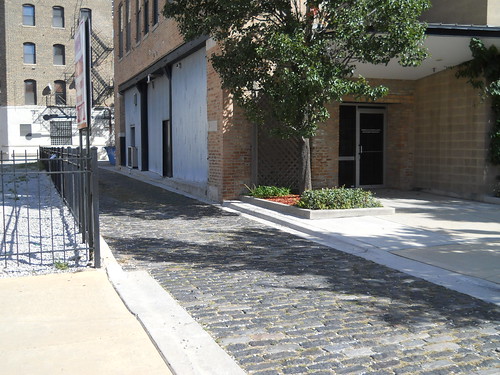 The alleyway from which the bomb was thrown. It had buildings on both sides of it back then.
The "Haymarket Riot" set off a storm not only in Chicago, but across the country. Martial law was declared in Chicago, and police raids were launched to shut down union halls and labor newspapers and arrest most of Chicago's labor leaders. In particular, the anarchists were targeted, and virtually every well-known anarchist in Chicago was arrested. Eventually, the police filed charges against eight defendants: Albert Parsons and Samuel Fielden had spoken at the Haymarket rally. August Spies was also a speaker at the rally and the editor of the local anarchist newspaper Arbeiter-Zeitung; when the newspaper's office was raided, assistant editor Michael Schwab and typesetter Adolph Fischer were also arrested. Oscar Neebe was a writer for the Arbeiter--he was arrested later. Local anarchist Louis Lingg was found with bomb-making materials in his apartment (though no one could connect him to the bomb which was thrown at the rally, and Lingg himself wasn't at Haymarket that night). And local anarchist speaker George Engel was the final defendant. Of the eight, only two were actually in Haymarket Square when the bomb went off--speakers Fielden and Spies. Two others, Parsons and Schwab, were there earlier but left for a nearby bar after Parsons finished his speech. Neebe was giving a speech in another town at the time; Engel was home playing cards. A ninth person, local anarchist Rudolf Schnaubelt, was suspected by police of being the actual bomb-thrower, but he had already fled the country. Parsons was indicted but had also left the area and was not initially arrested, but voluntarily surrendered to police just before the trial began, and took his place in the docket. Although the police could not tie any of the eight defendants to the actual bomb, they were all charged with conspiring to commit the bombing, on the grounds that by encouraging violent revolution in their speeches and writings, they had motivated the bomber, whoever he was, to act. Their real crime, of course, was being anarchists, union organizers, and political radicals.
 Bomb parts introduced as evidence during the trial. On display at the Chicago History Museum.
The jury selection took three weeks. Anyone who showed sympathy for unions, socialism or radicalism was dismissed by the judge, while jurors who expressed distaste for radicalism or anarchism were allowed as long as they declared they would be impartial. The defense used up all its peremptory challenges, and the jury was packed with anti-union and anti-anarchist citizens. Over the next two months, the prosecution presented 118 witnesses--none of whom could place any of the defendants there with a bomb or could establish any connection to the actual bombing. Instead, the prosecution argued that simply by being anarchists, the defendants had conspired to commit violence. On August 20, the jury convicted all 8 defendants, and sentenced seven of them to death (the eighth, Neebe, received a sentence of 15 years).
The trial, meanwhile, had become the focus of international protest. Labor unions, socialists and anarchists around the world condemned the charges as simple repression of radicals, and dismissed the proceedings as a mere show trial with a predetermined end. Telegrams flooded into the White House and the Governor's office demanding clemency or a pardon. On November 10, 1887, Governor Richard Oglesby, citing the lack of evidence that they were involved in the bombing, commuted the sentences of Fielden and Schwab to life in prison. Later that night, Lingg killed himself in prison using a blasting cap that had been smuggled in to him. The next day, Spies, Parsons, Engel and Fischer were all hanged. They are still known as "The Haymarket Martyrs".
On June 26, 1893, new Illinois Governor Altgeld signed an order releasing Fielden, Schwab and Neebe from prison, and retroactively pardoning the five dead Haymarket defendants. Altgeld concluded that the trial had been unfair and unjust, noting that the prosecution "never discovered who it was that threw the bomb which killed the policeman, and the evidence does not show any connection whatsoever between the defendants and the man who threw it," and that the defendants had been the victims of "hysteria, packed juries, and a biased judge."
In July 1889, at a convention of labor unions in Paris, delegates from the American Federation of Labor proposed that May 1st, the date of the original 8-hour day campaign that led to the execution of the Haymarket Martyrs, be declared "International Labor Day". The proposal was adopted unanimously. Since that time, May Day has been celebrated as Labor Day (usually as an official state holiday) in every industrialized country in the world from Mexico to Japan to Australia. Except one . . . in 1894, the United States officially set the first Monday in September, not May 1st, as "Labor Day". The US Department of Labor's website manages to give several pages on the "history of Labor Day" without once mentioning the word "Haymarket".
As for May Day in the US: when the Soviet Union was established in 1917, it immediately joined the rest of the civilized world (well, except for the US) in setting May Day as a national holiday. Over the years, though, as the Cold War grew, "May Day" in the Soviet Union became an exercise in military showmanship, as tons of tanks and missiles were paraded through Red Square to demonstrate the strength of the "Socialist Paradise". Labor movements in most countries just ignored the Soviet silliness. But in the United States, the Soviets could not be allowed to compete even in holidays, and so in 1958, at the height of the Cold War, the US declared May 1st to be "Law Day", a day, President Eisenhower proclaimed, when Americans would rededicate themselves to "the ideals of equality and justice under law in their relations with each other and with other countries". (Insert your own ironic joke here.)
There still remain some of us, however, who have not forgotten the original meaning of May 1st, and who still celebrate it as the true Labor Day.


